Crush Depth ROV: A Remotely Operated Vehicle for the MATE ROV World Championship
Abstract. Crush Depth's 2026 vehicle, GKAlloy, named for our late advisor Gurinder Khaira, performs simulated environmental-research and industrial-inspection tasks for the MATE ROV competition. Eight Blue Robotics T200 thrusters in a four-vertical, four-horizontal layout are driven from a Raspberry Pi 5 through ESCs and a PCA9685. The pilot has five cameras. Power arrives at 48 V DC on the tether and is stepped down through buck converters. The electronics sit on a three-layer drawer stack inside a 15.24 cm acrylic tube. The chassis, rings, and manipulators are SolidWorks-modeled and FDM-printed. Dry mass is 27.2 kg. As Co-CEO / CTO I led the electrical and software domains and designed the internal electronics mounts and the service stand. The chassis, housing, and manipulators are the work of the mechanical group. The vehicle competed at the World Championship in 2025 and 2026, and I received the Engineering Presentation MVP award in 2026. The documents the team submitted for 2026 are linked in Section 7.
1Mechanical Design
The pressure housing is a 15.24 cm (6 in) inner-diameter acrylic tube, lengthened from 30.48 cm to 38.10 cm when the electronics stack did not fit. The diameter was held so the chassis interface and end-cap tooling carried over. Inside, the electronics sit on a three-layer drawer stack the team calls the "Titanfall Battery": logic on top, power conversion in the middle, ESCs on the bottom. Each drawer slides out for service without disturbing the others, and the stack hangs from its own frame rather than the end caps, which fixed the sagging that compromised the seals on the previous vehicle.
The chassis rings were redesigned so any single ring can be removed without disassembling the base. A Picatinny rail carries the two manipulators and the cameras. The aluminum backplate was machined locally and anodized. Commercial WetLink penetrators were replaced by potted penetrators after repeated leaks, and SubConn wet-mateable connectors give a quick-disconnect tether interface.
The vehicle is trimmed slightly negative with a small forward pitch so the pilot can work close to the floor without active station-keeping. Table 1 gives the measured mass and buoyancy budget. A rearward pitch from the dense rear electronics was corrected with lead disks on the forward chassis ring.
Two manipulators are fitted: a two-degree-of-freedom four-bar parallel gripper with cutouts for PVC and rope, and a rotating end effector, a brushless motor through a 15:1 cycloidal drive, for the sensor-connection task. Five cameras give the pilot front, downward, and rear views in housings that pair SLA-printed enclosures with FDM-printed covers.
My mechanical contributions were on the serviceability side. The tether penetrators are epoxied into the backplate, and setting the vehicle down on its backplate loads those joints. I designed a stand that holds the backplate clear of the bench so the vehicle can be worked on and shown without pressing on the penetrators. I also designed the mounts that locate the electronics inside the housing.
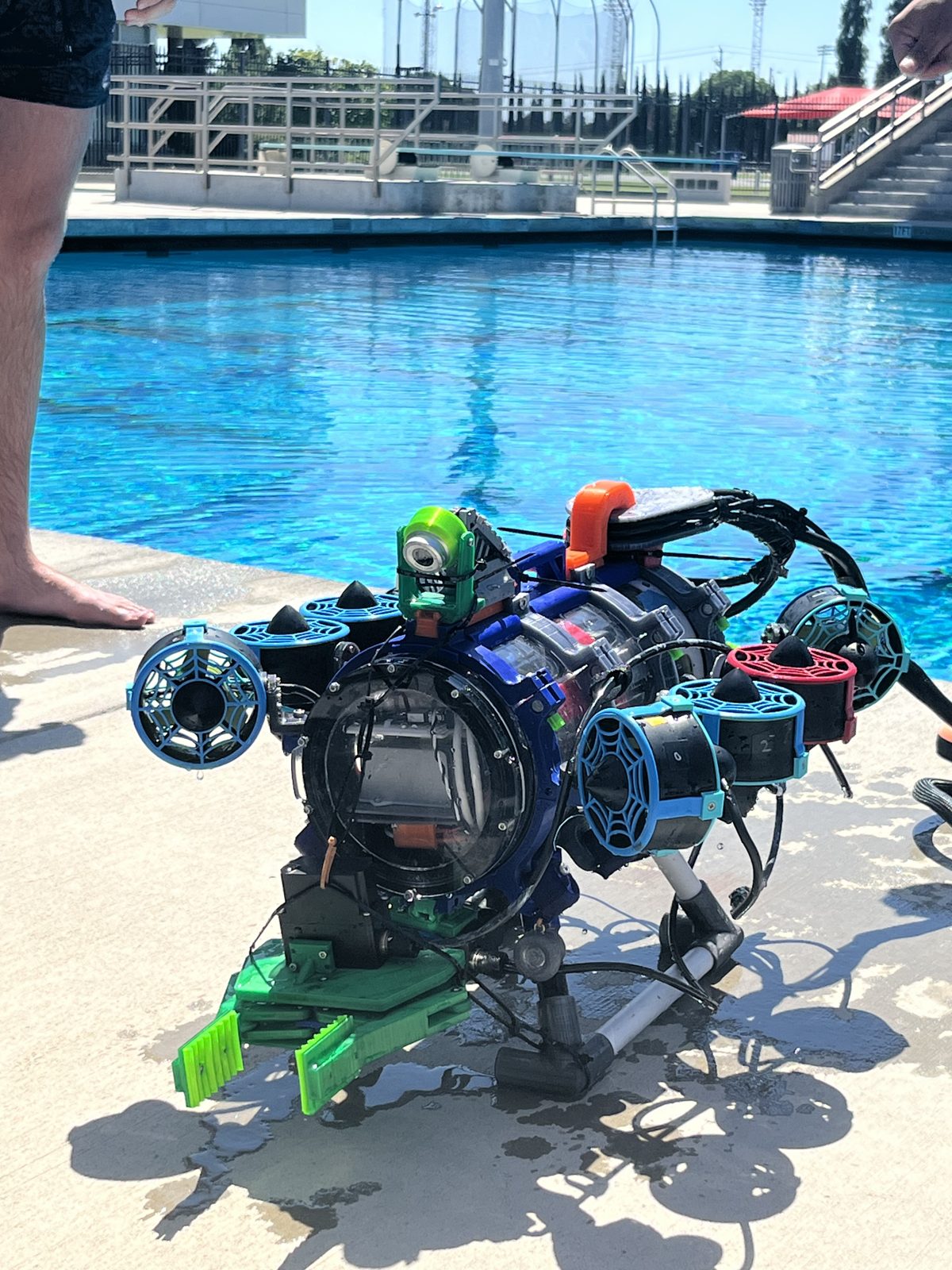
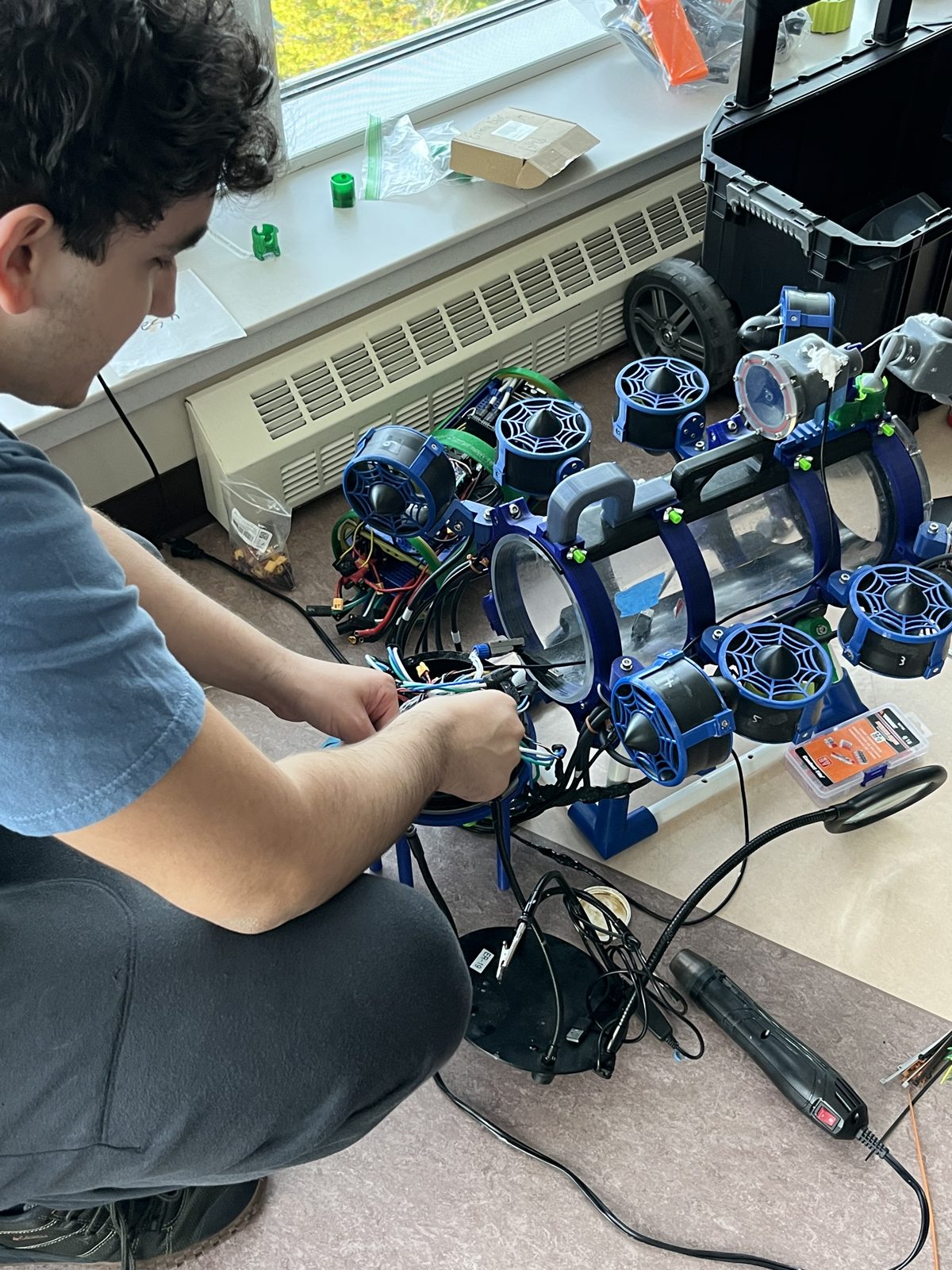
| Quantity | Value | Notes |
|---|---|---|
| Dry mass in air | 27.2 kg | measured |
| Displaced volume | 30.16 L | measured, about 7 L of it the housing |
| Buoyant force (fresh water) | 295.9 N | — |
| Weight | 266.8 N | — |
| Net buoyancy before ballast | +29.1 N | about 3 kg of ballast to neutral |
| Envelope | 60 × 50 × 40 cm | — |
2Electronics and Power
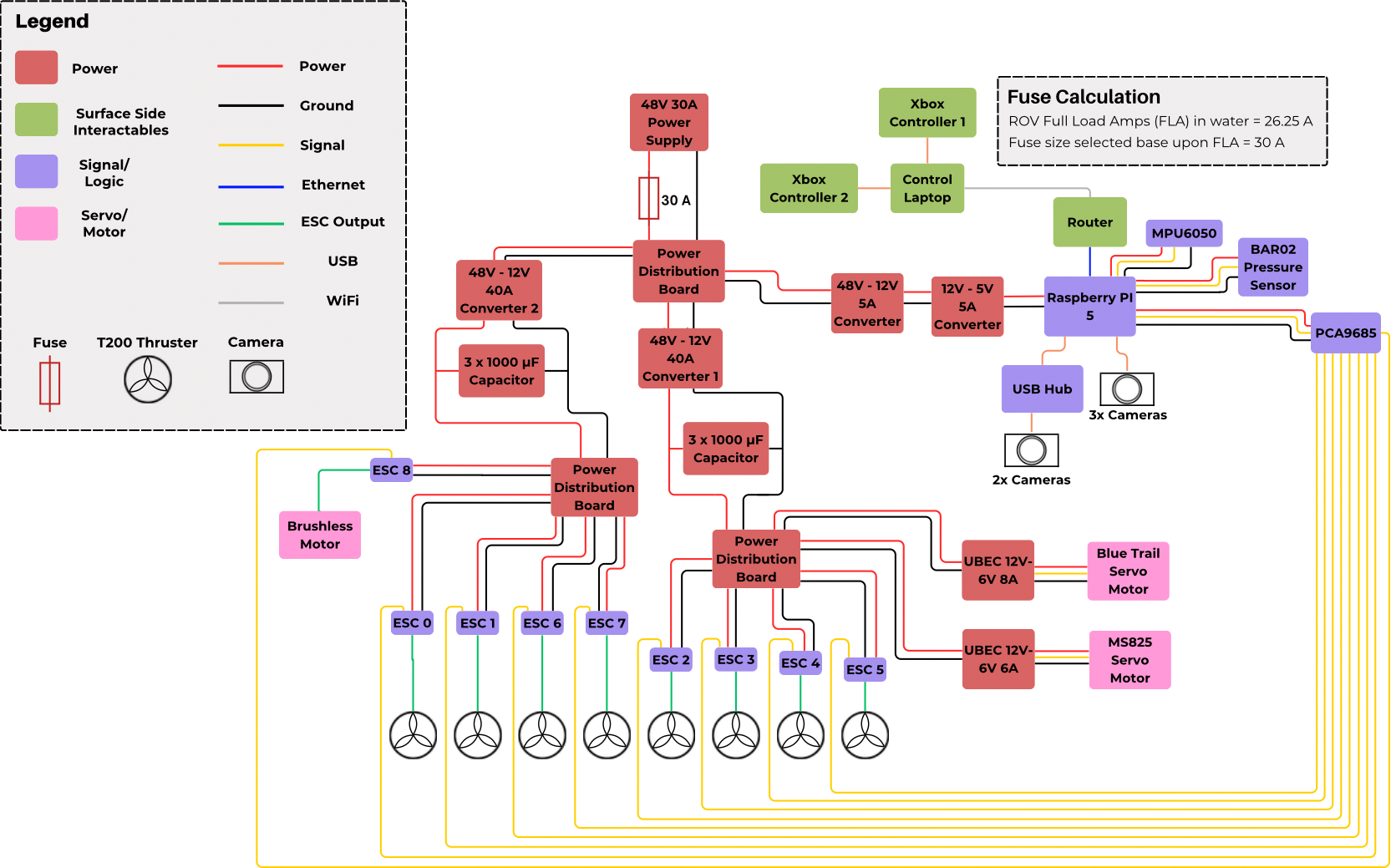
The electrical system is organized one subsystem per drawer layer so a fault can be traced to a layer. The top layer is logic: the Raspberry Pi 5, the PCA9685 PWM driver, the MPU-6050 IMU and Bar02 pressure sensor on a shared I²C board, a USB hub for the five cameras, and the 48-to-12 V 5 A and 12-to-5 V 5 A converters that carry the Pi. The middle layer is power: the main 48 V distribution board, two 48-to-12 V 40 A buck converters each with a 3 × 1000 µF bank on its output to absorb ESC switching transients, and two UBECs stepping 12 V to 6 V for the manipulator servos. The bottom layer carries nine ESCs, heat sinks up: eight for the thrusters and one for the rotating end effector.
Converter loads are split by function: one converter supplies the four horizontal thrusters and both UBECs, the other the four vertical thrusters and the ninth ESC. ESC signal lines run between layers through harnesses made from Cat 6 cable so the twisted pairs suppress crosstalk between adjacent PWM channels. The PCA9685's logic supply ties to the Pi's 3.3 V rail to protect the Pi's GPIO, while its output rail stays at 5 V for reliable ESC triggering.
Power arrives at 48 V DC from a 30 A surface supply through a 30 A fuse. The full-load current in water is 26.25 A, and the fuse was selected from it following the MATE fuse-sizing rule for the 2026 season. On the 12 V side, eight unrestricted T200s would draw about 136 A against the converters' combined 80 A, so PWM is hard-limited to 1228–1772 µs (about 7 A per thruster) and thruster outputs are scaled down in software. Realistic peak draw is about 56 A. The tether is 12 AWG wire for power and a single Cat 6 run for Ethernet. Figure 2 is the system interconnect diagram I drew for the 2026 vehicle.
| Subsystem | Component | Notes |
|---|---|---|
| Vehicle computer | Raspberry Pi 5 (16 GB) | multithreaded C++, 20 Hz control loop |
| Surface | Windows laptop, two Xbox controllers | Python application, UDP over Ethernet |
| Propulsion | 8× Blue Robotics T200, 4V + 4H | ESCs via PCA9685 PWM driver |
| Attitude | MPU-6050 IMU | auto-leveling PID on yaw, pitch, roll |
| Depth | Bar02 pressure sensor | rear-mounted for keel-depth reading |
| Vision | 5× camera (4× ELP 16 MP USB, 1× OpenMV) | SLA enclosures, FDM covers |
| Power | 48 V DC tether, 30 A supply, 30 A fuse | full load in water 26.25 A |
| Conversion | 2× 48–12 V 40 A, 48–12 V 5 A, 12–5 V 5 A, 2× UBEC 12–6 V | thrusters, Pi, servos |
| Structure | 15.24 × 38.10 cm acrylic housing, FDM chassis and rings | SolidWorks, Bambu Lab printers |
| End effectors | 2-DOF four-bar gripper and a rotating BLDC tool on a 15:1 cycloidal | Picatinny rail mount |
3Control Software
Control is split between a Python application on the surface laptop and a multithreaded C++ program on the Pi, linked by UDP over the tether's Ethernet. The surface side reads two Xbox controllers and sends a command packet at 20 Hz. UDP was chosen over TCP because a dropped packet is superseded by the next one rather than retransmitted stale. On the Pi, the control loop checks that a valid packet arrived within the previous 250 ms and, if not, stops every thruster and returns the servos to neutral. Thruster mixing is direct arithmetic on the movement axes, so a thruster relocation is a coefficient change rather than a code change, and an auto-leveling PID on the MPU-6050 applies yaw, pitch, and roll corrections when enabled. A slow mode caps thruster output for fine work. Code is version-controlled on GitHub, with the Pi pulling over SSH so the deployed build always matches what was committed.
4Testing
Waterproofing was validated by staged submersion: housings, cameras, and sealed compartments were tested empty at about 1.8 m for 10-, 20-, and 30-minute intervals before any electronics went in. The one failure this caught was a rear backplate that kept detaching when the vehicle was lifted from the pool. A team member in the water beside it traced the cause to a pinhole leak in one penetrator, which let water in while trapped air pressurized the housing.
On the software side, the stale-packet cutoff was checked with a packet-loss simulator, the thruster safety wrappers by commanding out-of-range PWM and confirming the cutoff engaged before the ESC, and the mixer by replaying known inputs on a dry stand while a logic analyzer captured PWM on every ESC channel. During 2026 testing an ESC on a vertical thruster failed with no spare on hand, so the team disabled that thruster and its diagonal counterpart and finished the run, which is the redundancy case that justified eight thrusters over six.
5Team and Role
Crush Depth is a 48-member team drawn from the Engineering Renaissance Club at Clovis Community College and structured like a company per MATE guidelines: five chief officers, nine technical leads, and their subteams. I am Co-CEO / CTO, co-managing the team with Luke Salazar. The Surface Side, Sensors and Autonomy, Electrical, and Control Systems subteams report to me, and the mechanical subteams report to him as CDO. I was promoted from Float Team Technical Lead. Before the 2026 season the two of us restructured the technical-lead system from broad departments into these smaller subteams.
Operations at this scale are their own engineering problem. The season runs on a weekly Gantt chart. The chief officers set the top tiers, the technical leads fill in the lower ones, and a four-week daily lookahead runs before major deadlines. Every subteam justified its design decisions to the CDO and CTO through a trade-study report before a recommendation was accepted. As CTO I wrote the club's electrical safety manual and the power-system safety check that precedes every test, and co-reviewed the job safety and environment analysis for competition operations. The 2026 World Championship was held at the Marine Institute of Memorial University in St. John's, Newfoundland. The team logged 3,532 design and build hours on the vehicle.
At the 2026 World Championship I won the Engineering Presentation MVP award.
6Known Limitations
- No in-loop telemetry reaches the surface, so the pilot cannot see thruster current or IMU readings during a run.
- The 250 ms stale-packet window causes a perceptible pause on a congested network.
- Converter sizing was validated by operation. Per-rail current draw was not logged.
- Bar02 depth feedback for station-keeping is wired but not yet used by the control loop.
- Manipulator payload capacity is unquantified.
7Competition Documents
The documents Crush Depth submitted to the MATE judges for the 2026 World Championship, unedited.
- Technical Documentation, 2026 (PDF, 27 pages, 21 MB). Design rationale for every subsystem, safety, testing, accounting, and the system interconnect diagram.
- Spec Sheet, 2026 (PDF, 1 page). Vehicle summary and full team roster.
- Job Safety and Environment Analysis, 2026 (PDF, 6 pages). Deck and dive operations across the wave, flume, and ice tanks, prepared by the safety officer and reviewed by the CEOs.
- Marketing Display, 2026 (PDF, 1 sheet, 24 MB). The poster shown at the championship. It took first place in the Explorer class.